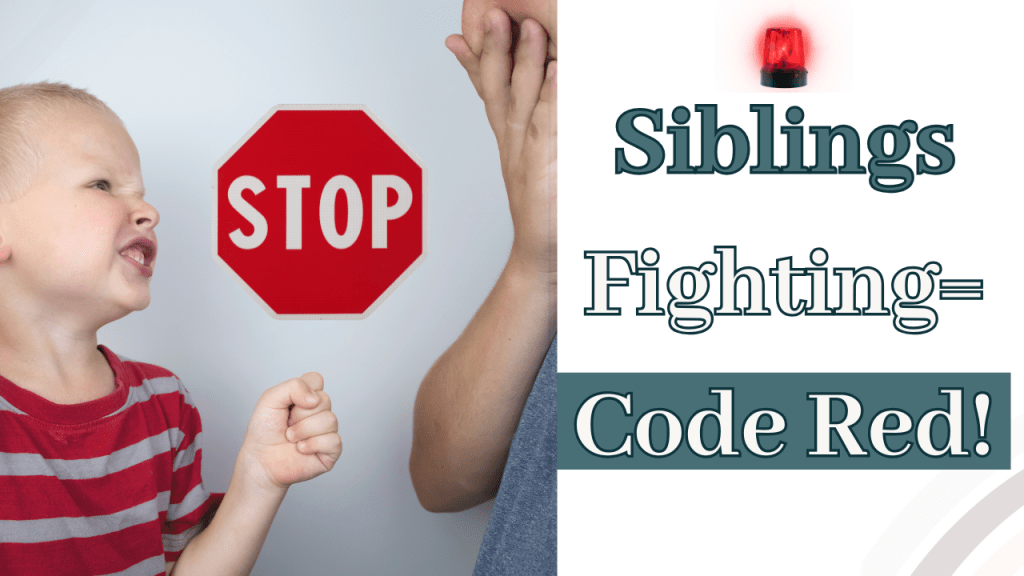
Do your toddlers have moments of aggressive or unsafe play where they do not listen and their behavior gets worse? Do your toddlers constantly get into fights with their siblings, causing you to worry about everyone’s safety? Heather calls these stressful toddler moments Code Red Zones.
Pulling from both her experience as a teacher and as a twin mom, Heather walks us through how to identify these Code Red situations and their underlying causes so that we can catch them before they escalate or prevent them entirely.
**Listen to the full podcast episode here, or read on for the tips!
What is a Code Red Zone?
Code Red Zone: A critical moment where your toddler’s behavior is posing an immediate safety risk, either to themselves or others, and their behavior escalates quickly and starts to effect the family dynamic.
As a Teacher
Heather started calling these high stress moments Code Red Zones partly pulling from her teaching years. As a special education teacher, Heather taught a range of ages and grade levels, all the way from pre-K to 10th grade. When she taught 9th and 10th graders, she was in a special high risk behavior unit and all the teachers had walkie talkies to be able to communicate in stressful situations. If one of the students, a teenager, went into a full blown meltdown, they would call out to the rest of the team, saying, “Code Red!” In these situations the goal was to get the situation under control and keep everyone safe.
As a Toddler Mom
She also calls it a “zone” because she has noticed her own twin toddler boys get into a zone where it seemed like nothing would get through to them, where their impulse control does not seem to be functioning at all. Of course, this is a common zone for toddlers to be in as they develop impulse control over a long period of time and we often don’t see it function consistently until grade school. But these zones can be especially dangerous when you have two toddlers in this zone together, either feeding off each other or in a fight, and their actions are getting out of control, making you want to call in support: “Code Red!”
Identifying Code Red Zones
Code Red moments happen during some of the most stressful situations with our toddlers.
- Touching hot ovens or stoves
- Sibling rivalries escalating into physical harm
- Biting and hitting during care giving
- Rough play with siblings or pets
- Throwing toys in uncontrolled environments
These behaviors by themselves can be stressful enough, but they become truly code red zones when we give a boundary or guidance and our toddlers do not listen and even resist our help, doubling down on the unsafe behavior—a situation on top of a situation.
EXAMPLE: A mom is cooking with her toddler in the kitchen.
- The toddler is up on a stool so she can help, but there are many unsafe or messy things on the counter that she can reach and she begins to touch all of the things she should not be touching.
- Mom says, “Don’t touch those things, we are using these things over here.” But the toddler does not stop and continues to touch the unsafe things.
- The mom then enforces a boundary, removing the toddler from the counter and kitchen, and the toddler has a complete meltdown and tantrum, kicking screaming, throwing, and hitting.
- What was at first an isolated incident now starts to become a pattern. Every time the toddler is invited to help cook she immediately touches things that she shouldn’t and gets removed. This behavior is even spreading to other activities and times of the day.
Underlying Causes
There can be many different triggers for a pattern of behavior like this, some due to development and others due to personality and needs. If we can identify the underlying cause, we will be better equipped to respond and even stop code red moments before they happen.
Cause #1: Developmental Need
When toddlers play roughly, they might be looking for sensory feedback as well as learning about cause and effect. They will throw and drop things just to see what happens, or want to touch everything to experience different shapes and textures. They are driven by a developmental need to learn about the world around them by interacting with it in many ways, which can sometimes get them into dangerous situations.“
Proactive Strategy: Offer a Positive Alternative
Sometimes, just showing our toddlers a more appropriate way to play with a toy (or sibling or pet) will allow them to continue pursuing their developmental need, but direct their energy in a safer way.
EXAMPLE: A toddler who is throwing toys
- If your toddler is in a throwing mood, throwing toys all around in a dangerous way instead of playing with them, you can offer for them to go outside and throw balls, throw soft objects, or play catch with you instead.
When Offering an Alternative Does Not Seem to Work
Maybe you have tried giving your toddlers the more appropriate alternative and it did not seem to help them stop the dangerous behavior.
EXAMPLE
- Your toddler is ramming a push toy into the oven while you are trying to cook and bake in the kitchen.
- You say, “No pushing your toy into the oven. That is dangerous. You can push your toy in the hallway instead.”
- Instead of following your redirection, your toddler gets a spark in his eye and he continues to push that boundary and ignore your redirection.
So what do we do now?
This is where things get more complicated and confusing for parents. In a moment like this, the behavior might NOT be driven by a need for sensory input or cause and effect learning, though it could have started that way. It could now to driven by a toddler’s want for independence and desire to push boundaries, which is why this interaction becomes a power struggle.
Cause #2: Asserting Independence
When using a redirection strategy triggers a power struggle, our toddlers behavior might be fueled by their growing sense of independence. They start to want to keep doing what they are doing and not what we have asked them to do instead.
This drive to exert their will grows stronger as toddlers hit middle and late toddlerhood, so it is often common for them to enter into a war of wills over boundaries that we set. This doubling down reaction is also more commonly seen in toddlers with certain temperament traits, such as a very strong willed or independent personality. When the toddler is told to stop pushing the toy in the kitchen, he automatically wants to persist and continue his unsafe play.
It is very stressful and frustrating for parents when an approach that might have worked with a younger toddler or a toddler of a different temperament does not seem to work with their child now, and even backfires into an escalation of intense, focused behavior that seems unstoppable. In cases like these, we need to consider deeper strategies that address what is behind and underneath the behavior.
Proactive Strategy: Give Choices OR Let Them Create a Plan
One way to honor our toddlers need for independence is to give them choices within our boundaries so they feel like they have some control over their own lives. With an older toddler, you could even ask them to join you in problem solving and come up with a plan for a better way to play. If they feel like they get to choose what to do instead, they may be more likely to follow through, diffusing the power struggle.
Cause #3: Attention Seeking Behavior
Another underlying reason that toddlers act out in this way is to get our attention. Competing for attention is a common sibling dynamic for this reason. One child might be trying to get noticed above the others and may even act out to get that attention. This is called attention seeking behavior.
Toddlers will do almost anything to get our focused attention, even if it is negative attention. If, when they act out and engage in dangerous behaviors, they get a lot of our undivided attention, they may continue in that behavior whenever they can just to get our attention again.
EXAMPLE: An older toddler acting like a baby
- A newborn baby cries and a young toddler screams, both for attention, because they do not yet have the words or the ability to ask for attention.
- An older toddler, who does have words and some ability, might see that the young toddler and the baby get immediate attention when they scream and cry, so the older toddler mimics the younger siblings by screaming and crying like them to get attention in the same way.
Proactive Strategy: Find Moments to Give Positive Attention
To help break a negative attention seeking pattern, we want to give as much attention as we can to positive behaviors and positive interactions instead of negative ones. This means we want to be noticing good behavior during calm moments and not just correct behavior in the middle of chaotic moments. When we are fully present with our toddlers during calm moments, taking the time to connect with them and give them warm, loving attention, they may be less likely to seek out our attention with negative behavior.
Cause #4: Behavior Amplification
Siblings can also trigger each other’s emotions and amplify them. This is what Heather calls behavior amplification. When a toddler pushes a sibling’s buttons, either by being in the sibling’s personal space or taking a toy from them, that can send the sibling into a fit of screaming, hitting, biting, kicking, and throwing. The other sibling may get pulled into this behavior too, resulting in a physical conflict that continues to escalate. These types of sibling dynamics all add to the intensity of code red zones.
Proactive Strategy: Build Sharing Skills and Verbal Conflict Resolution Skills
Outside of moments of conflict and behavior amplification chaos, practice and praise sharing skills and verbal conflict resolution skills like asking for a turn with a toy instead of taking it, or saying, “space please” when a sibling is in their personal space.
Conflict resolution skills and sharing skills are so important for toddlers to learn and there is too much information on them to share here, but stay tuned for deep dives into both coming soon! You can also check out Heather’s many podcast episodes on sibling dynamics and sharing.
If you find yourself needing more parenting tools and support, you can also sign up for the free Transform Aggressive Toddler Behavior and Tantrums Guide and Workshop here!

Hi! I’m Dabney, mom to three boys in three years! I found Heather through her podcast while searching for tools to help my own toddler’s aggressive outbursts and button pushing behaviors. Few voices in the parenting world address how to manage the intensity of these toddler behaviors when you have not just one but two or more children with you.
Enter Heather, an educator for ten years turned twin mom of two boys with stories and strategies that highlight how to manage these hard moments while also being outnumbered. I participated in her Transform Aggressive Toddler Behavior and Tantrums Workshop and Cohort and found her strategies simple and effective. Not only is my parenting better for it, but I am growing in my confidence along this journey collecting tools along the way.
 Toddler Toolkit