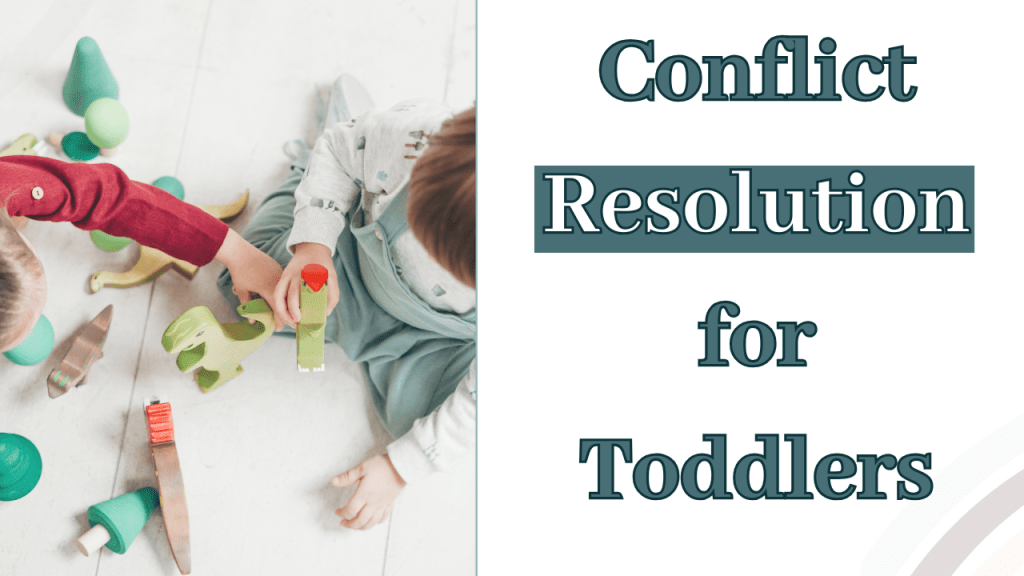
Do your toddlers knock others down, fight over toys, or hit, kick, and bite their siblings? Because of their still developing emotional awareness and self-regulation skills, these kinds of conflicts between toddlers are very common. How can we help our toddlers navigate these tricky situations and intense emotions?
Heather has seen some misinformation online about this topic and hopes to clear it up with practical building block steps that prioritize safety, holding calm and loving boundaries, and meeting our toddlers where they are to help them learn the critical social and emotional skills they need.
**Listen to the full podcast episode here, or read on for the tips!
Misinformation and Incomplete Advice
While online, Heather came across some advice that seemed backwards and potentially harmful. In a scenario where one toddler runs into and knocks over a sibling, the advice was for the parents to not step in and let the toddlers figure out conflict resolution on their own, even at two and three years old. This approach cites that learning to work out conflicts on their own is good for toddlers, saying “it toughens them up!” and asserting that “they will learn turn taking and sharing in Kindergarten” so there is no need to focus on that.
But is this the full story? Heather doesn’t think so. Some young toddlers might be able to resolve a few conflicts on their own, but these toddlers might be older, more advanced, or already have more basic building block skills in place, which this advice seems to disregard. Trying to teach conflict resolution to our toddlers by letting them figure it out on their own without having a foundation of basic skills is backwards and will be very difficult for them to do.
Prioritize Foundational Cooperative Skills
In order to get to more complex conflict resolution skills, we need to prioritize supervised play as we focus on sharing and communication skills as well as cooperative turn taking. These are the foundational skills that will allow our toddlers to build the conflict resolution skills they need.
Because conflict resolution is a complex skill, we need to understand where our toddlers are developmentally so we can practice the skills in ways that will be the most helpful for them.
- 1 to 3 Years: Toddlers at these ages do not have fully developed empathy and do not really understand that other people have feelings and experiences that are different from theirs. Much conflict at this age, especially physical conflict, needs adult supervision and intervention. If left to “work things out” on their own, someone is going to get hurt. We need to prioritize safety and teach basic sharing and turn taking skills, practicing, modeling, and praising as much as we can.
- 3 to 5 Years: On average children develop a better understanding of social rules and norms at these ages because they have been observing them for longer. They start to internalize cause and effect lessons from their social experiences. They also have a better understanding of sharing and turn taking and may be able to share and ask for a turn without prompting, especially if they have been practicing those skills early on. In moments of conflict, we should still be prioritizing safety and be near enough to step in if a situation escalates.
- Elementary School Age and Up: When our toddlers get to elementary school age they are really starting to develop empathy. This is where we see many children resolve conflicts more independently as they learn to negotiate and to compromise with others. But even still, they will need guidance from time to time, as we all do. Solving conflicts with others is hard to navigate, even for adults.
The Building Blocks of Conflict Resolution
Building Block #1: Model Conflict Resolution for Your Toddler
One of the most important things that we can do to help our toddlers build good conflict resolution skills is to model how to handle conflicts calmly and respectfully. This can be so hard, especially when we as parents are dealing with physical conflict between siblings. When we see one sibling hurting another it is easy to jump in with our own aggressive, upset energy which can escalate the situation even more.
Instead, we want to prioritize staying calm and assertive so that we can share our calm and diffuse the situation. Our toddlers will need to regulate their own emotions after a conflict and they often need our help. It is very difficult to calm our toddlers down if we are not first calm ourselves.
Building Block #2: Identify Emotions
Identifying emotions is one of the five key skills Heather recommends all toddlers learn. The sooner we talk about a wide range of emotions, how they feel in our bodies, and what we can do about them, the better.
In a moment of conflict, we can name the emotions that we see our toddlers experiencing to help them understand and process them. A toddler who is hurt is likely sad and upset, while the one who hurt the other might be angry or frustrated.
We also want to be sure to have conversations about emotions in calm, everyday moments. We can use books, toys, and role playing social situations to help grow their emotional vocabulary and understanding.
Building Block #3: Encourage Replacement Behavior
If our toddlers are engaging in a negative behavior, they need a positive behavior to replace it with. If we don’t give our toddlers something to do instead, they will keep going back to what they know. We want to be actively teaching and encouraging a more appropriate behavior.
EXAMPLE: Teach a phrase to say instead of lashing out physically
- While playing with his brother, one of Heather’s toddlers was upset over a toy.
- Instead of having a full down meltdown like he could have, he flopped to the floor with a giant frown on his face and said, “I’m sad!”
- Heather responded with empathy, “I’m so sorry your sad!”
- Then her toddler moved on!
Because Heather had worked on naming emotions with her toddlers, her one toddler was able to verbalize how he felt in a moment of distress instead of hitting or throwing. He had a skill he had practiced to use in place of an emotional meltdown
Building Block #4: Work on Sharing and Turn Taking
Cooperative skills like sharing and turn taking are two more of the five key skills Heather identifies that all toddlers should learn. Toddler siblings, especially, are faced with situations where they need to share every day, from sharing the same toys, to sharing their parent’s attention.
Contrary to the misadvice, this is not something that we should wait to work on until preschool or kindergarten. Parents are their children’s first and most important teachers. When you teach your toddlers sharing and turn taking skills, you are giving them two very important building blocks for conflict resolution.
Again, we can teach sharing and turn taking through modeling these skills in our own interactions with our toddlers, by practicing them through games and activities, and praising our toddlers whenever we see them using these skills.
Building Block #5: Have Consistent Boundaries and Consequences
Lastly, we need to make sure we have consistent rules and expectations for our toddlers. Here are a few steps we can follow.
- Make sure your toddlers know the rules. When we see conflicts escalating, we want to make sure that our toddlers know that hitting, biting, throwing, and kicking is not appropriate or safe behavior, and it can hurt others and our things.
- Hold the boundary: If a toddler continues to hurt another, we intervene calmly and consistently, enacting swift boundaries to keep everyone safe. This might look like separating the siblings or removing a toy that was used to harm another.
- Comfort the hurt toddler: We want to make sure that we check on and comfort the hurt child and then address the other toddler’s behavior. Maybe you remove the hurt child to be with you in another room, maybe you remove the other sibling and go back to sooth the other.
- This can be challenging for one parent to do, so at times when both my toddlers are upset and cannot be left alone, I stay in the same room with both and position myself as the physical barrier to separate them.
- Talk about what to do differently next time: Once we have helped the hurt toddler, and maybe set up an independent activity for them, we can address the behavior of the sibling. We want to understand what happened in the conflict and identify what our toddler should have done instead. Are they missing a key skill that they need to practice? Do they need a phrase to say or to be reminded to ask for help instead of taking matters into their own hands?
- Follow through with consequences: Once we figure out what caused the conflict, we can follow through with consequences. If every time one toddler has a particular toy, they ram it into their sibling, we might need to put that particular toy away for a while. Or we might need to be more active in supervising sibling play until we see less conflict.
- Repair: After addressing the negative behavior and coming up with a plan to practice a better replacement behavior, you can encourage your toddler to apologize and repair the relationship with the sibling in some way. Depending on your family and each situation, you and your toddler can decide what you want that apology and repair to look like.
The End Goal: More Independence
The more we work on these foundational skills, the more we will see our toddlers work conflicts out on their own. It is so satisfying and encouraging to hear my toddlers playing in another room and notice a disagreement that might have normally ended in an all out fight get worked out through asking questions and offering turn taking solutions instead. The more my toddlers have used their skills, the better they get, and the more independent they become.
Now, here is where the original misadvise has a ring of truth: As my toddlers have learned to use these skills, they often do play better when I am not physically present to be the moderator, because they do figure out how to work things out more naturally when I am not there to be called upon for every little thing. But these early conflict resolution skills would not have been possible at this stage without the practice of the fundamental sharing and communication skills first, with me present to walk them through the steps and guide them along the way.
The goal is not to always be hovering over our toddlers to make sure they resolve every conflict perfectly, but rather give them the communication and cooperation skills to use, be available to step in when needed, and then stand back and cheer them on as their skills and abilities grow.
If you find yourself needing more parenting tools and support, sign up for the free Transform Aggressive Toddler Behavior and Tantrums Guide and Workshop here!

Hi! I’m Dabney, mom to three boys in three years! I found Heather through her podcast while searching for tools to help my own toddler’s aggressive outbursts and button pushing behaviors. Few voices in the parenting world address how to manage the intensity of these toddler behaviors when you have not just one but two or more children with you.
Enter Heather, an educator for ten years turned twin mom of two boys with stories and strategies that highlight how to manage these hard moments while also being outnumbered. I participated in her Transform Aggressive Toddler Behavior and Tantrums Workshop and Cohort and found her strategies simple and effective. Not only is my parenting better for it, but I am growing in my confidence along this journey, collecting tools along the way.
 Toddler Toolkit