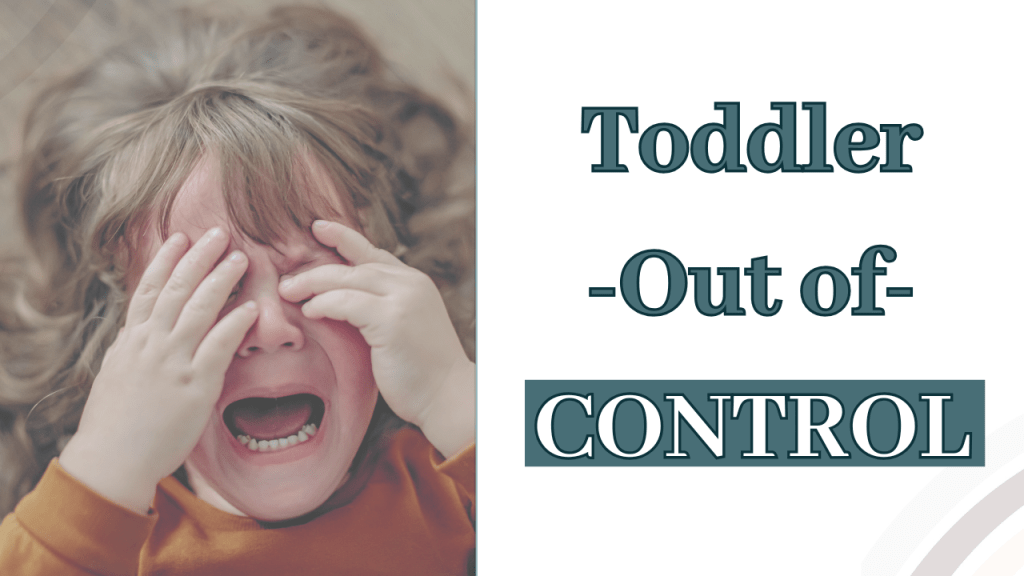
When your toddler’s behavior gets out of control, it can be so hard to know what to do to help regain peace in your home. If your toddler is stuck in a cycle of escalating aggressive behavior, like hitting, biting, screaming, and throwing, and nothing you do seems to help, they might be stuck in what Heather calls the Toddler Reactivity Loop. Being stuck in this stressful cycle can negatively impact family dynamics and make even normal life seem impossible.
In this post and podcast episode, Heather does a deep dive into why our toddlers get caught in this vicious cycle, how it effects the family as a whole, and what we can do about it.
**Listen to the full podcast episode here, or read on for the tips!
Getting Stuck in the Toddler Reactivity Loop
If our toddler is stuck in the Toddler Reactivity Loop, they might seem to hear the word “no” or “stop” as an invitation to double down on their behavior. What started out as a mild power struggle might become a repeated pattern where our toddler’s behavior is triggered when we state and hold boundaries and actively escalates every time. This leaves us confused, reactive ourselves, and unsure what to do to stop the negative cycle.
Toddlers Love Repetition
Why does this happen? As any toddler parent knows, toddlers love repetition and can latch onto patterns immediately.
EXAMPLE
- When my oldest was a toddler, he once ran down the sidewalk instead of walking to the car. No amount of calling him helped him come back, so I had to eventually chase him down and carry him to the car.
- The very next day, as we were walking out the door, I saw him look from the car to the sidewalk. It was like I could see his gears turning, remembering how fun it was to run away the last time, and off he ran to the sidewalk just like he did before.
- I could see that this impulse was becoming a pattern and I knew that if I didn’t get ahead of it and break the cycle somehow, it might get worse.
Attention Seeking Behavior
Another reason our toddlers can get stuck in this loop is because of the negative feedback we sometimes give them that can actually fuel that action more. Toddlers crave our attention, whether positive or negative. Our toddlers will still accept negative attention as adequate attention because, in their minds, it is better to have negative attention than no attention at all.
This is why our own frustrated, overly harsh, or annoyed tones can backfire with our toddler doing more of exactly what we just told them not to do. When we add our own heightened emotional energy to a behavior, our toddlers feed off that energy. To help keep our own reactions from contributing to the Toddler Reactivity Loop, we want to try to get ahead of our own emotions by having a planned response and keeping a level tone.
Even when we feel like we are staying calm, holding boundaries, and trying to collaborate on solutions to get ahead of the repeated patterns, sometimes they still perpetuate and our toddlers get stuck.
If this is you, you might have experienced the frustration that being stuck in this loop causes. When different approaches all seem to fail, we can become increasingly discouraged as our toddler’s behavior worsens. Their behavior may start to negatively impact the family dynamic leading to what Heather calls the Family Fracture Phase.
The Family Fracture Phase
If your toddler is stuck in the Toddler Reactivity Loop where their behavior is escalating and causing more and more stress to you and other siblings and family members, if their behavior is making even daily tasks seem incredibly difficult and extra activities near impossible, and you find your patience wearing thin, you might be in the Family Fracture Phase.
Many Contributing Factors
Along with a toddler who is stuck in the Toddler Reactivity Loop for a prolonged amount of time, there are other factors that lead to the Family Fracture Phase. When we are in the middle of big life changes and extra challenges on top of toddler parenting challenges, the added external stresses can increase the likelihood of entering this phase.
- Having a toddler and a new baby: Adding a new baby is big transition for the whole family.
- Having twins or multiples: Parents of multiples have the added stress of juggling sibling dynamics of siblings of the same exact age and stage, which can be especially exhausting in toddlerhood.
- Lack of sleep: For various reasons, our toddlers might be up many times in the night or up early in the morning. When they drop their naps, get sick, have allergies, or experience nightmares they are more likely to have interrupted sleep leaving both parents and toddlers more tired and irritable than normal.
- Work stress, financial pressures, and burnout: External factors can add to the stress at home.
- Disagreements in parenting style: If you and your partner do not fully agree on parenting styles, that can be confusing to the child and cause a rift in the parent’s relationship if not resolved.
- Lack of support: Maybe you don’t have family close by, or friends in the same stage of life, leading you to feel isolated with little to no support.
- Family injuries from aggressive behavior: When our toddlers bite, hit, kick, or throw objects they can cause harm to us and others, leading to the home not feeling safe.
- Other big changes: Life changes such as death in the family, moving, divorce, or any other big life changes can add stress to our plate as well as our toddler’s.
When these stresses compound, parents can go into survival mode, which puts us into a more reactive state. We are exhausted, overstimulated, and burnt out. These fractures can effect family dynamics in many different ways, making family time difficult and trips and activities feel impossible.
EXAMPLES
- A family takes a trip to the beach but the parents struggle so much with their children being out of control, throwing sand, getting in fights, not listening, and getting into power struggles, that they feel like they have to leave early and cannot come back because the experience was so difficult.
- When behaviors are difficult at home, sometimes it feels like getting out of the house will help change the mood, but in the family fracture phase, even simple outings to the park can be a challenge. No matter how much positive connection and fun you have while out, you and your toddler still fall into the same cycle of power struggles and aggressive behaviors as soon as you are home.
Will my toddler grow out of this phase?
A common question Heather has heard from families stuck in the Toddler Reactivity Loop or Family Fracture Phase is, “Will my toddler grow out of this phase?” The answer is yes, they will likely grow out of it as they mature, and while this is comforting to hear, we don’t want to use this as a reason to no nothing. The longer these phases go on, the greater the chance that our children will form negative self-regulation habits, social skills, and behavioral patterns based on these times of high stress. They can carry these learned patterns into their elementary years, teenage years, and even into adulthood.
Even if our toddlers will grow out of this phase naturally, why would we prolong it any longer when we might be able to shorten the time by finding better approaches that work for our individual families? If you and your toddler can get the support you need now, family relationships can improve in a matter of days or weeks.
Heather’s Story
As a teacher for ten years who had a lot of experience with a range of ages and stressful classroom situations, Heather considered herself a naturally patient person. However, even with all her experience and her naturally patient personality, she experienced being in the Family Fracture Phase with her twin toddlers who were dropping their nap, were getting stuck in the toddler reactivity loop, and feeding off of each other’s energy as well as Heather’s reactivity due to lack of sleep and unsafe behaviors.
- For two months Heather’s twin toddlers were dropping their nap, getting overtired, fighting bedtime, and waking up multiple times in the night.
- Heather and her boys were overstimulated and more reactive from being on all day, not getting breaks, and then being on throughout the night. Her toddlers started to became more aggressive and out of control.
- The tipping point for Heather was when her back got injured by one of her toddlers. After that incident, she noticed she would get immediately triggered by her twins aggressive behavior and snap. They really struggled with throwing toys inside and rocks outside and hitting. She did not feel safe.
- The behaviors kept getting worse and Heather spiraled and knew she wasn’t being the parent she wanted to be. She knew her own reactivity was adding fuel to the fire and that if things were going to change, she needed to do something.
- She began researching and formulating a new plan based on everything she knew from her years of teaching, her observations of her own unique toddlers, and child development.
- Finally, Heather was ready to implement her new approach. Within a day their family dynamic was already starting to turn around. There were a few days of mild boundary testing, but overall she went from seeing power struggles most of the time, to rarely at all. Heather was able to help her family out of the family fracture phase and has not reentered it since.
Heather cares deeply about helping other families get out of the Family Fracture Phase because she has been there herself. She wants to help parents connect with their toddler’s unique personality and needs and create custom plans to help reset the family dynamic, get out of survival mode, and thrive again.
Heather has put together much of the research she did to help her own toddlers in her free Transform Aggressive Toddler Behavior into a Kind, Calm, and Caring Toddler Workshop and Guide. Don’t wait to get the help you need!

Hi! I’m Dabney, mom to three boys in three years! I found Heather through her podcast while searching for tools to help my own toddler’s aggressive outbursts and button pushing behaviors. Few voices in the parenting world address how to manage the intensity of these toddler behaviors when you have not just one but two or more children with you.
Enter Heather, an educator for ten years turned twin mom of two boys with stories and strategies that highlighted how to manage these hard moments while also being outnumbered. I participated in her Transform Aggressive Toddler Behavior and Tantrums Workshop and Cohort and found her strategies simple and effective. Not only is my parenting better for it, but I am growing in my confidence on this journey, collecting more tools along the way!
 Toddler Toolkit