Does your toddler sometimes get upset by something seemingly minor and you don’t understand how so much emotion could be triggered by something so small? Maybe your toddler starts screaming at the mere mention of a snack even when you said he will get one in five minutes, or your toddler cries because you gave her the pink cup even though that one is usually her favorite. Whats going on?
Sometimes, our toddlers’ tantrums are not actually about the things that triggered them. Heather wants to help parents get to the bottom of these tantrums so parents can more clearly see what’s actually going on under the surface and how we can help!
**Listen to the full podcast episode Why Toddlers Really Throw Tantrums
**Listen to the full podcast episode Your Toddlers Tantrums Aren’t What You Think
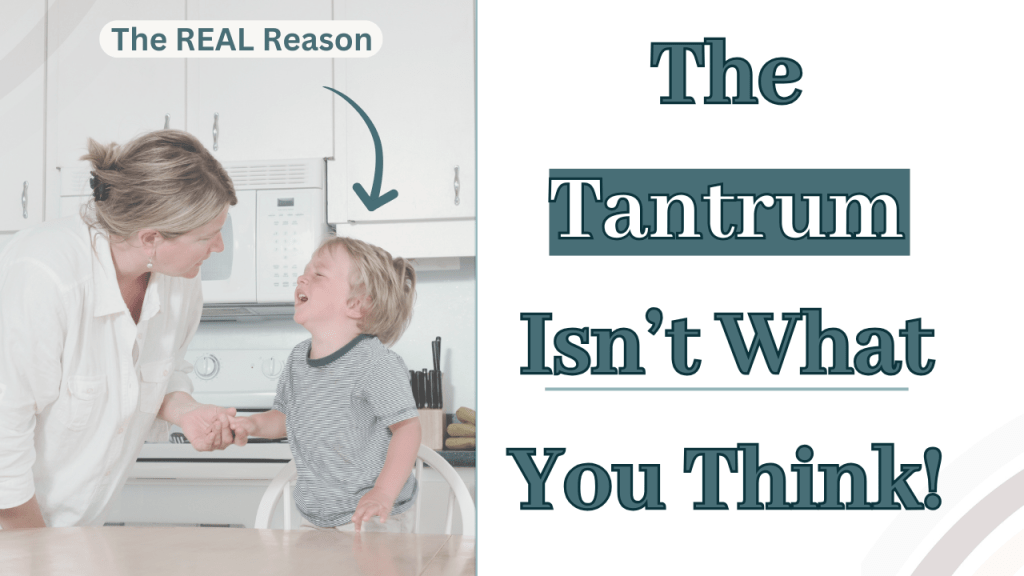
Tantrums Might Not What We Think
One of these types of tantrums happened when Heather’s twins were two.
- The situation: Heather’s husband was putting batteries in a remote controlled car that he had just gotten for their twin boys. He was planning on taking them out to the playground and driving it around there at a later time. He told the twins that they would be able to play with the car when they got to the park.
- The tantrum: The toddlers were so excited about the toy cars, but since they had to wait they went off to play with other toys. Then, all of a sudden, one of the twins got upset with another toy he was playing with. He was saying that it was broken and he got so frustrated that he threw it. Heather’s husband went over to see what was wrong, thinking that something about this other toy must be upsetting his toddler.
- Sometimes not what we think: Sometimes, when our toddlers are upset about something, the thing that set them off is not actually the cause of the tantrum. It could be the last straw, but maybe not the root cause of their outburst. Often the real problem that started the upset is unseen or not as obvious, but if we figure out what the real root is, we can resolve the tantrum much easier and connect with our toddlers’ true needs better.
- The root of the tantrum: The real reason Heather’s toddler was throwing a tantrum was that he was having a hard time waiting to play with the remote controlled cars. He wanted to play with them right away and when he heard that he couldn’t play with them yet, he got upset and took it out on another toy.
- Following a familiar pattern: When Heather’s toddler was melting down, he started screaming familiar phrases, things that he usually says when he is upset, even if they don’t always apply to the immediate situation. He was screaming, “Broken! Not working!” even though there was nothing wrong with the toy he was saying that about. When his dad went to go check on him, he also pushed him away saying, “No Dada! Go away!” and hit him, another reaction he often had when upset.
Heather was in another room for this particular tantrum and when she came back everyone was upset. After a while, she helped her husband get the toddlers ready to finally go to the park and as soon as her upset twin was ready to go and outside, his mood completely changed. After seeing him go from upset to happy again that quickly, Heather realized that his tantrum likely had nothing to do with the toy he had been playing with, but instead the fact that he had to wait to go to the park.
This is an example of how our toddlers might say they are upset at something, like saying a toy is broken or that they don’t want the pink cup, even though that’s not the real reason they are upset. Our toddlers often use familiar words or action to show their frustration even if they have nothing to do with the root cause of their upset. Those behaviors and phrases are the symptom, not the true issue itself. If we recognize the symptom as just that, a symptom, then we can better understand our toddler’s patterns and find what they really need help with.
Why Toddlers Really Throw Tantrums
Though it is developmentally normal for toddlers to melt down over the wrong color plate or not getting what they want right away, the reason is that our toddlers are missing key skills, like understanding time, being able to wait, and dealing with disappointment. Some of their missing skills are short term skills and some are more long term skills, but there are big and small steps we can take to help our toddlers begin to build both sets of skills so that their understanding grows and the tantrums decrease.
Short Term Skills and Their Triggers
Short term skills are ones that our toddlers lack that we can see changes in relatively quickly once we start working on them. Every toddler is different, however, and has different skill levels, strengths and weaknesses, so this list may not apply to all toddlers even though the general principle still applies. If your toddler is already close to a skill, you will see progress sooner than if they really struggle with that skill.
- Listening skills: If our toddlers are more prone to tantrums and don’t seem to listen to us, there are ways we can better prompt and support them, verbally and non-verbally, to increase their ability to understand us and follow through with what we say. Here is a whole blog post on tips for listening.
- Communication skills: If our toddlers struggle verbally or there are important words they don’t fully understand, they are going to have a communication breakdown. Maybe your toddler is pushing other children because they don’t know how to ask for space. Maybe they are running away from you when they are upset instead of using their words to tell you. A tantrum like this is often a response to not knowing how to navigate a stressful situation.
- Sharing skills: If a toddler does not know how to share or take turns with toys, they will likely grab, scream, hit, and tantrum for toys. There are many ways we can build up our toddler’s ability to share and understanding of turn taking, many of which are explained in this blog post.
- Low frustration tolerance: If our toddlers throw, hit, or bite when they are frustrated, they may not know a better way to express frustration. You can coach them in different replacement behaviors, like throwing soft balls, hitting a pillow, or biting a chew toy as well as teaching them how to verbalize frustration instead.
- Asking for help and basic needs: When our toddlers feel hungry, tired, or sick, they are more likely to tantrum over things that usually don’t bother them. If we are able to identify when they are acting out of basic needs, we can meet those needs and help them know what they were probably feeling. Our toddlers sometimes don’t know how to ask for our help so we can give them the words so they can better understand themselves and learn.
Long Term Skills and Their Triggers
Long term skills are ones that even older children and adults often are still learning, like emotional regulation and patience. These skills take longer to develop, but that doesn’t mean that there is nothing we can do. We just want to remember that we will be taking small steps towards these bigger skills, laying a foundation that we will continue to build upon as they grow.
- Dealing with disappointment: When our toddlers get upset over the color of a cup, they might be showing us they don’t know how to deal with the disappointment of not getting what they want. As our toddlers grow, they have more opinions and preferences and sometimes picture a scenario going in a specific way. This is what Heather calls a “picture perfect mindset.” When they are then told no and things don’t go as they expected, that can trigger a meltdown. Learn more about what to do when toddlers meltdown when they don’t get their way in this blog post!
- Flexibility: Toddlers thrive on routine and often have a hard time with big changes, like dropping their nap, going to preschool, or potty training. Preparing your toddler ahead of time by reading books, talking about it, or creating visuals can really help make changes smoother for all.
- Processing lots of stimulation: Toddlers get overstimulated quickly by outings, lots of people, and lots of noise which can lead to big meltdowns. If you are in an overstimulating environment with your toddler, pick out a relatively quiet spot where you can take them to calm down if they need.
- Emotional regulation: Our toddlers ability to recognize and control their own emotions is just starting to develop, which is why toddlers’ emotions tend to all explode at once. Learning to name and control emotions is a lifelong skill, but we can start showing them how by naming the emotions we see in them and helping them find ways to calm down. We can also name our own emotions when we are feeling them and show our toddlers how we regulate ourselves.
- Transitions: There is a reason toddlers often fight nap time, bedtime, mealtime, or having to get out the door. Transitions from one activity to the next are difficult for them, especially when they go from a preferred activity, like playing, to a less preferred activity, like nap time. Having a visual schedule and talking about when things are happening can help.
- Waiting: Waiting can be so hard for toddlers because they have a limited understanding of time. If they hear the word snack or park, they might want it right that instant and not understand why they can’t. We can help by making time more concrete with a visual timer that shows a color block of how much time there is left.
These steps toward both short term and long term skills will help our toddlers be able to navigate more and more tricky situations without tantrums. When we support our toddlers, meet them where they are, and teach and practice important life lessons, we will see their confidence and independence grow.
And as always, if you find yourself needing more parenting tools and support, sign up for the free Transform Aggressive Toddler Behavior and Tantrums Guide and Workshop here!

Hi! I’m Dabney, mom to three boys in three years! I found Heather through her podcast while searching for tools to help my own toddler’s aggressive outbursts and button pushing behaviors. Few voices in the parenting world address how to manage the intensity of these toddler behaviors when you have not just one but two or more children with you.
Enter Heather, an educator for ten years turned twin mom of two boys with stories and strategies that highlighted how to manage these hard moments while also being outnumbered. I participated in her Transform Aggressive Toddler Behavior and Tantrums Workshop and Cohort and found her strategies simple and effective. Not only is my parenting better for it, but I am growing in my confidence along this journey collecting tools along the way.
 Toddler Toolkit