We have all heard the phrase “sharing is caring,” but that saying has recently been called into question in online parenting spaces where some have claimed that sharing can actually harm children. One of the problems with parenting advice online is the reliance on short form content to relay information. Short videos and captions can be problematic when discussing the complex topic of child development because there is not enough time to give these topics the nuance and explanation they need.
Here, Heather discusses sharing and turn taking in a more fleshed out way, explaining their differences and similarities along with concerns that have been raised. Her goal is to thoroughly explain these topics and help parents not get lost in attention grabbing, misleading soundbites.
**Join Heather in this conversation by listening to the full podcast episode here, or read on for the insights!
What is Sharing?
Sharing involves giving and receiving items or attention. We can share a whole thing (like a toy or snack) or just part of it (one toy from a set or a few snack pieces). Sharing often happens naturally between toddlers and siblings in a voluntary way.
EXAMPLES
- A toddler has a cup of fruit and gives a piece to a sibling or friend.
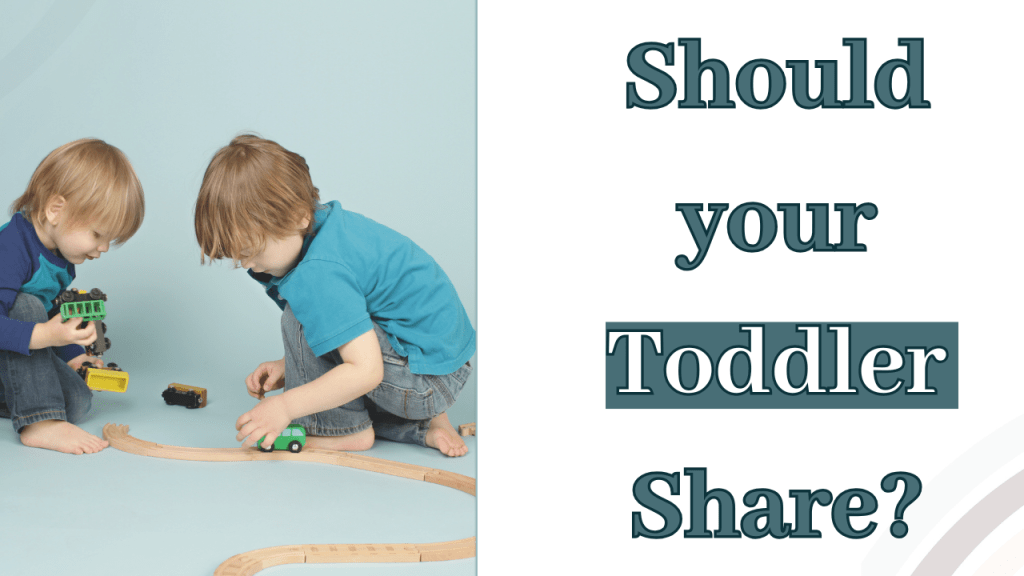
- Two or more toddlers are all playing with the same set of toys, maybe animals and a barn, blocks, or toy cars.
The examples of sharing that we often see on social media show a situation where one child has a toy that another child wants, leading to someone forcing the first child to give the toy up. This negative portrayal then suggests that all sharing is bad.
But not all sharing scenarios even involve a toddler giving up a toy at all. That’s why it’s important to remember that sharing can be playing with the same set of toys all at the same time.
What is Turn Taking?
So now that we know what sharing is, what is turn taking and how it different than sharing? Turn taking involves waiting for ones turn to use something that is being used by someone else. The main difference between turn taking and sharing is that turn taking is more structured and involves waiting skills, which means it may not happen as naturally without being taught and practiced, especially at young ages.
EXAMPLES
- Two children want the same toy car and a parent helps them take turns playing with it for certain amounts of time.
- Two children want to read the same book and decide to take turns with the book. While one child is reading the preferred book, the other child waits by looking at other books. When the child is done reading, the other gets a turn.
Turn taking and sharing can also be interwoven in some instances.
- Two children are playing a game of bowling where they are sharing the game (playing together) and taking separate turns tossing the ball at the pins (turn taking).
Social Media Examples
In online parenting spaces, sharing has lately been criticized. One short form post that Heather came across stated that “sharing is not caring” and another video implied that a focus on sharing causes people pleasing. This type of content tends to have controversial titles that grab people’s attention, but because the videos are so short they often don’t give enough explanation or nuance. Even when these posts contain a bit more information, they still can be misleading for parents, especially ones who don’t watch the entire video or don’t read the caption.
Social Media Example #1: “Sharing Is Not Caring”
The first video Heather saw online lead with the statement that “sharing is not caring,” contradicting the commonly heard phrase saying that it is. The explanation of the post conveyed that the person who posted this considered sharing harmful to children.
Sharing is Carrying, but with Boundaries
Heather’s response to this statement and idea is that sharing is caring, but with boundaries. It is important for children to have personal boundaries and not to have to share everything, especially if they are currently using a toy or activity, but it is also important to remind them that sharing is a good option.
Sharing is collaborative and should be presented to our children as a positive, pro-social skill, not one that is dangerous to them. When we teach turn taking and other sharing skills, we teach fairness, patience, and the building blocks of empathy.
So while Heather does not agree with the concept that teaching sharing is going to mess up your child, she also does not agree with the social pressures that sometimes make parents feel like they have to make their children share. It is good to offer for your child to share and also respect their decision if they don’t want to share at that moment, letting them know that another child can use the item when they are done with it.
EXAMPLE
- Heather’s toddlers were playing in the play space at the library. They were using a wooden puzzle when another child came up and wanted one of the pieces, wanting them to share the puzzle.
- Heather offered for her toddlers to share a puzzle piece, showing them they could give the child one piece and still play with the rest, but one of her toddlers didn’t want to.
- In that moment, Heather could have told her toddler to give up the puzzle, forcing him to share, but instead she said, “That’s fine. Let’s finish the puzzle and when we are done he can have a turn.”
Heather gave her toddler the option to share voluntarily and still respected that he didn’t want to, moving on to a turn taking solution instead, emphasizing that others would get a turn when they were all done.
How do we teach sharing without forcing?
The example above is one way to go about teaching your child to share without forcing it on them. Other ways to do this include:
- Praising sharing that happens naturally, labeling it, encouraging it, and giving it our positive attention.
- Model sharing for them in our own interactions, sharing with them and others and labeling it.
- Practice by playing turn taking games or having a shared sets of toys that many children play with at the same time.
- Use simple language to explain sharing and turn taking in so that they can more easily understand.
We will go deeper into how to teach sharing skills, step by step, in Sharing Part 2.
What do you do if a toddler is hording toys?
One downside to only hearing how we should never force children to share is that we forget about the possibility that there might be a child who gets excluded from play because another child has toys that they refuse to be done with. What can we do to encourage a child to share when they seem to be hording and withholding toys from others?
- Look for the “why” behind the behavior: There might be a few reasons a child is refusing to give up toys. Is it a favorite toy? Do they think that they want it or need it, but that’s not really what’s behind their actions? Maybe they actually need emotional support but are clinging to a toy for control.
- Having clear expectations: Setting up clear expectations about what toys are for everyone to share and what toys can be kept back can help in situations of hoarding. It is okay for children to have certain favorite things that they can decide to share or not, giving them some control over a few special items, with the expectation that the rest of the toys are shared so that everyone has the opportunity to play with something.
- Teaching and modeling empathy: We can ask our children what it would feel like for them if they never got a chance to play with toys because someone else was always keeping them for themself. We could also point out the emotions of another child who feels left out or excluded.
Social Media Example #2: People Pleasing vs. Healthy Sharing
In the other post Heather saw, a woman at the gym was using workout equipment when someone asked if they could use it. She instantly felt like she had to give it up when she was asked, even though she wasn’t done. She then blamed her people pleasing tendencies on having to share as a child, always having to put others needs before her own, thus claiming that sharing as a child made her a people pleaser.
Heather considers this an example of unhealthy sharing because there were other ways to have shared the workout equipment without giving it up completely if she wasn’t done, like offering to take turns. Forced sharing might impact someones development of people pleasing tendencies, but there are many other factors that contribute to these tendencies.
Laying all the blame on sharing for people pleasing can cause parents unnecessary guilt and fear for wanting their children to know how to share. As Heather noted before, teaching sharing in a positive way emphasizes empathy, kindness, and finding a balance between respecting one’s own needs and considering others.
What Actually Causes People Pleasing
- Attachment Style: A person’s attachment style can have an influence on whether or not they develop people pleasing tendencies. The different kinds of attachment styles are 1) secure attachment, 2) anxious attachment, 3) avoidant attachment, and 4) fearful attachment. A child with a more fearful or anxious attachment style can be more likely to have people pleasing tendencies.
- Parenting Style: The parenting style a child is under can also have an impact on the development of people pleasing characteristics. Three parenting styles are 1) authoritarian: controlling and harsh, 2) authoritative: boundaries with love (which includes conscious parenting and gentle parenting,) and 3) permissive parenting: no boundaries or consequences. Children who grow up with more controlling authoritarian parents may have a greater chance of developing people pleasing tendencies.
- Personality and Temperament: A child’s individual personality traits might naturally lead to people pleasing. A person can be strong willed, highly sensitive, or easy going. A more sensitive child may fall more easily into people pleasing than a strong willed child.
- Cognitive Factors: Other cognitive factors can contribute to people pleasing like a child’s level of empathy and self esteem.
- Different Cultural Expectations: Different cultures expect different things from parents and children and those different social pressures can lead to more or less people pleasing tendencies, especially in public settings.
With this deeper dive into sharing and turn taking, Heather hopes to take the worry off of parents. We are constantly hearing what we are doing wrong and parent with the fear that we are going to mess our children up if we make any missteps. We need to be careful what we consume online, finding others that will encourage us in our parenting journeys, not tear us down. No parent is perfect, but we are doing the best we can with the knowledge we have.
If you find yourself needing more parenting tools and support, sign up for the free Transform Aggressive Toddler Behavior and Tantrums Guide and Workshop here!

Hi! I’m Dabney, mom to three boys in three years! I found Heather through her podcast while searching for tools to help my own toddler’s aggressive outbursts and button pushing behaviors. Few voices in the parenting world address how to manage the intensity of these toddler behaviors when you have not just one but two or more children with you.
Enter Heather, an educator for ten years turned twin mom of two boys with stories and strategies that highlighted how to manage these hard moments while also being outnumbered. I participated in her Transform Aggressive Toddler Behavior and Tantrums Workshop and Cohort and found her strategies simple and effective. Not only is my parenting better for it, but I am growing in my confidence along this journey collecting tools along the way!
 Toddler Toolkit
One response to “Sharing Part 1: Toddler Turn-Taking and Sharing Explained”
[…] Part 1, we talked about how sharing is a positive, pro-social skill that helps develop a child’s […]
LikeLike