Picture this, you are at the library with your toddlers and they are running around trying to take books and activities away from other children. What do you do? How do you help your children respect others boundaries and share?
In Part 1, we talked about how sharing is a positive, pro-social skill that helps develop a child’s fairness, patience, and empathy. But sharing is also not something we want to force on our children or others in a harsh, negative way. So how do we teaching sharing skills to our toddlers without forcing them to give toys to others or forcing others to give toys to them?
Heather shares her tips and examples for how to build and encourage sharing skills, giving both parents and children tools to navigate tough social situations with grace, calm, and less meltdowns.
**Listen to the full podcast episode here, or read on for the tips!
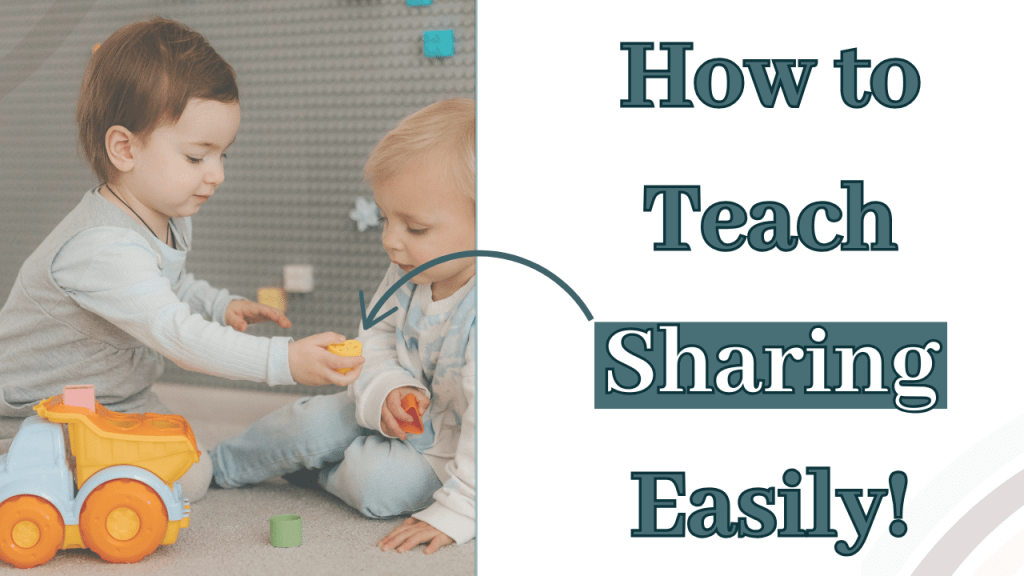
Why Do We Teach Skills?
Our toddlers are learning from us, others, and the world around them every day. They are constantly learning cause and effect, the meaning of words and concepts, and how to relate to things and people around them. As our children’s first teachers, we can and should give them the building block tools for navigating emotions, social relationships, and the natural world we all live in.
Teaching building block skills like sharing and patience at these early ages can help prevent toddler meltdowns. Even though meltdowns are developmentally normal and will still happen, teaching skills gives our toddlers proactive strategies for how to navigate common toddler triggers, like sharing and waiting, so that they begin problem solving in those situations as they continue to grow.
Tips for Teaching Toddlers Skills
Teaching toddlers can be difficult because they are still so young and don’t always understand what we are trying to communicate. Heather has a few great tips that can help keep teaching quick and simple so that our toddlers can understand skills and concepts better with less tantrums and less meltdowns.
Tip #1: Catch Mini Teaching Moments When They Naturally Happen
Our toddler might be using a skill, like sharing, in their interactions with others without even knowing it and we just haven’t drawn attention to it before. Maybe our toddler gave part of a snack to a friend or let a sibling have a toy when they were done with it.
We want to call out those moments when they happen naturally and we can turn them into mini teaching moments where we connect the word “sharing” to a positive action they did. Our toddlers want our attention and praise, so when we give that to them for positive behavior they are more likely to continue in that positive behavior. What we water with our attention grows!
Tip #2: Make the Explanations Simple
When we are explaining a new concept to our toddlers, we want to make sure to choose words at our toddler’s level and bring in examples and concepts that they already know. We might simply explain the expectation that the toys at the library are for everyone to play with, or we could point out the happiness of a child that they just shared with.
Even if your toddler is not very verbal, you can use simple sign language, which is also a great non-verbal prompt to use when we don’t want to be verbally repeating ourselves over and over again. However we chose to explain sharing to our toddlers, we want to help them connect the dots between the actions of sharing to the word “sharing” in a positive way.
Tip #3: Repetition is Key
If we take our toddlers to the library and want them to share with others, but haven’t practiced that skill at home beforehand with siblings or ourselves, we haven’t set them up for success. Just like us, toddlers need to practice and repeat a skill many times before they can use that skill under pressure in new environments.
We also want to repeatedly give them opportunities to practice those skills in public places, like the library or the playground, especially if we expect them to navigate sharing in group settings. Our toddler’s first time in a group setting might not go well which is very normal. Toddlers get overwhelmed and overstimulated easily by new and challenging things, triggering meltdowns more frequently than normal. But with consistency, new things become routine and normal, which is where our toddlers thrive.
Tip #4: Use Skill Building Chains
As we think about how to teach big life skills to our toddlers, we want to be building that skill from the simplest form up. Heather calls this making skill building chains. These skill building chains are customizable for each toddler.
Depending on the toddler’s age and unique personality traits, one toddler might struggle more with sharing multiple toys in a set with others while another struggles more with sharing one toy at a time. Whichever skills are the simplest and easiest for your toddler are the ones you want to teach first, and then you can work up to the more complex skills.
Chain 1: Point out and praise when they use the skill naturally.
The most basic way to teach or encourage a skill is by calling it out and praising it when they naturally use the skill. “You shared!”
Chain 2: Model the skill to them.
This arguably could also be the most basic way to teach because our children will naturally copy what we do. We can intentionally set up scenarios where we share with them and point it out, “Mama shared with you!” or where we point can point out when we share with others and why.
Chain 3: Practice the skill using play.
As you introduce more formal sharing and turn taking, you can use a game that requires quick turns, like taking turns putting a coin in a piggy bank or shooting a ball into a hoop. Especially you are early in the learning stage keep it short, sweet, and fun, giving lots of positive feedback, then move on. You can build up their tolerance for sharing over time.
Chain 4: Set up the environment to share for a longer amount of time.
As our toddler’s tolerance for sharing grows, we can start having them practice sharing for longer amounts of time, like sharing a favorite book. Books take longer to look through, so while one sibling gets a few minutes with the favorite book, we can help the other child wait by looking at other books or engaging in a separate activity. We can also prompt the other child if needed when it is time to be done and give a turn to their sibling.
Chain 5: Set up a shared set of toys to be shared in a group setting.
This could be anything from a set of toys in the sandbox or a bin of blocks that are being used by a few children. Like Heather mentioned above, some toddlers may struggle more with formal turn taking and sharing one object at a time, so we can switch up the order if needed.
How Teaching Sharing Skills Prevents Meltdowns
Sharing can be a big meltdown trigger because our toddlers feel a lack of control. If they see another child playing with a toy that they want and feel like they will never be able to have it, or if they don’t want to be done with a toy because they fear they will never get it back again, they are going to feel very out of control. But if they understand that sharing and turn taking means that they will get a turn with a toy or will get the toy back again, they will feel less anxious and out of control.
Taking it a step further, when we teach our toddlers the skill of sharing, how to ask for a turn, how to wait for another child to be done, how to cooperate with others calmly, we are teaching our toddler that they actually do have control in a situation by sharing. Having this sense of control back fills their independence bucket, giving our toddlers a sense of control in their world. Sharing helps them become more independent and feel less frustration while navigating social situations, leading to less meltdowns.
Putting it all together, when our toddlers take a toy at the library we can:
- Set boundaries and encourage sharing. Remind your child that it is not kind to take toys that others are playing with. You can offer for them to find something to play with that is not being used yet, or ask for a turn and wait until the other child is done.
- If your toddler still wants the toy, model how to ask for a turn, coaching them in what to say. “If you want to play with this toy next you can say, ‘Turn please?’”
- Praise your toddler when they ask for a turn, wait, or give a toy to another child when they are done.
- Practice and build up these skills at home with games, siblings, and modeling them yourself.
And remember, even toddlers who practice and know these skills will still struggle sometimes. This does not mean our toddler is not learning, but that they are human just like us. When we stop expecting our toddlers to be perfect all the time, we can see struggles, not as failures and setbacks, but as valuable teaching moments.
And if you find yourself needing more parenting tools and support, sign up for the free Transform Aggressive Toddler Behavior and Tantrums Guide and Workshop here!

Hi! I’m Dabney, mom to three boys in three years! I found Heather through her podcast while searching for tools to help my own toddler’s aggressive outbursts and button pushing behaviors. Few voices in the parenting world address how to manage the intensity of these toddler behaviors when you have not just one but two or more children with you.
Enter Heather, an educator for ten years turned twin mom of two boys with stories and strategies that highlighted how to manage these hard moments while also being outnumbered. I participated in her Transform Aggressive Toddler Behavior and Tantrums Workshop and Cohort and found her strategies simple and effective. Not only is my parenting better for it, but I am growing in my confidence along this journey collecting tools along the way.


One response to “Sharing Part 2: How to Build Sharing Skills”
[…] Sharing skills: If a toddler does not know how to share or take turns with toys, they will likely grab, scream, hit, and tantrum for toys. There are many ways we can build up our toddler’s ability to share and understanding of turn taking, many of which are explained in this blog post. […]
LikeLike