Does your toddler seem to say “no!” to your every request, making even simple to-dos feel like a battle of wills? Toddlers who have entered the “no” phase are often looking to assert their independence, but sometimes they actually don’t have the skills they need in order to do what we have asked. How can we handle this tricky phase and help our toddlers turn some of those no’s into yes’s?
Heather is here to help by explaining some of the many reasons our toddlers say “no” and how we can teach and support them while helping them out of a negative rut by focusing on the positives.
**Listen to the full podcast Handling the “No” Phase: How to Get Your Toddler to Listen Without a Battle
**Listen to the full podcast episode 20 Seconds to Yes: Getting Toddlers to Wear Helmets
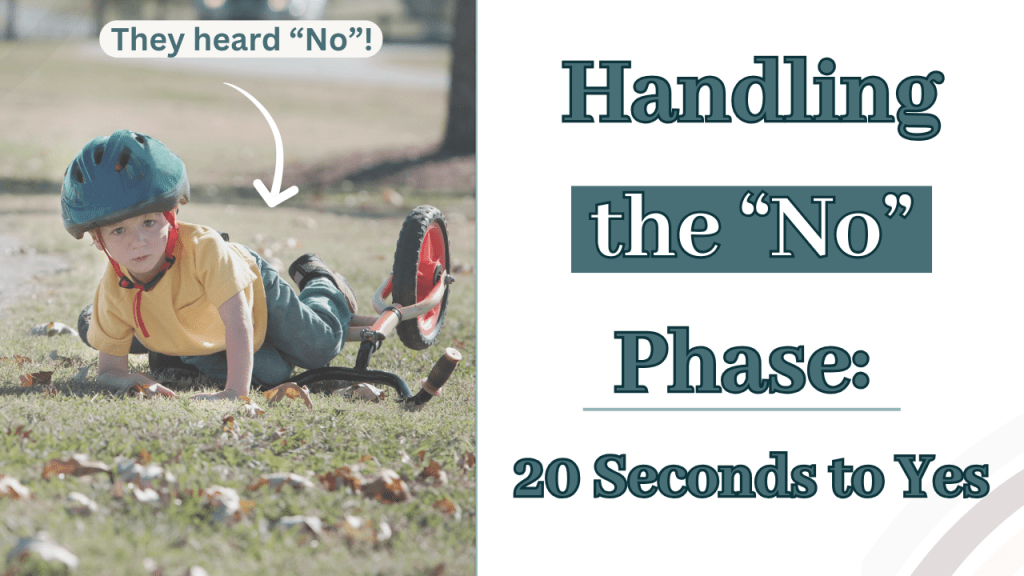
Why Our Toddlers Say No
Reason #1: They are Overwhelmed
When our toddlers are overwhelmed by a task, they are much more likely to refuse to do it. If they don’t fully understand what we are asking them to do, or they don’t know how to do it on their own, they will use their ability to say “no” as a way to run away from the situation.
EXAMPLE
- Someone asks our toddler to put on his shoes, but he doesn’t have that skill yet, so he says “no” and runs away, avoiding the situation all together. He doesn’t want to do it because he doesn’t know how.
Sometimes our toddlers say no because they don’t know how to ask for help instead. This can happen when we ask our toddlers to clean up their toys and they refuse. It might not be that they don’t know how to put the toys away, but that they are overwhelmed by the mess and don’t know where to start and need to ask for help.
When our toddlers refuse to put away their toys, one way we can respond to help them learn to ask for help is by offering to help, giving them the words and the direction to know where to start.
EXAMPLE
- Giving them the words: “It’s time to clean up now. Do you want Mama to help you? Say, ‘Help, please!’ Let’s clean up together.”
- Showing them the actions: Our toddlers get overwhelmed by mess just like we do. By cleaning and organizing toys alongside our toddlers, we can help them learn how to break down a big overwhelming task, like a big mess, into small manageable tasks, like focusing on putting away blocks first, then cars, then stuffed animals.
We can take this same approach if our toddlers are saying no at transition times, like leaving the park, having to leave in the morning for pre-school, or needing to get ready for bed. We can come alongside our toddlers and offer to help make the transition fun or break it down into smaller chunks, maybe giving a countdown for leaving the park or having shoes and socks right by the door in the morning.
Reason #2: They are Seeking Autonomy
When our toddlers are seeking autonomy, saying no is their way of exerting control over their world, their environment, and their place in the family. Part of toddler development is realizing that they are their own person separate from us with their own wills, likes, and dislikes. If we say that it’s time to leave the park, they might want to be the one to decide when they are done playing, so they say “no!”
If your toddler is exploring their ability to make choices and assert control in this way, here are some things to consider:
- Your toddlers temperament traits: All toddlers typically go through a “no” stage, but some toddlers may be naturally more strong willed and independent than others, making it more likely that they will say no to everything and get into power struggles often, so it’s important to consider their personality. For more about understanding your strong willed toddler, read this blog post.
- Button pushing behavior: Strong willed toddlers can also be more likely to know how to push our buttons, trying to control the situation by getting a reaction from us. Button pushing, attention seeking behavior like this is very tricky and often needs to be met with specific strategies. If your toddler is seeking your attention negatively, especially with aggressive, button pushing behavior, check out this blog post.
- Where they are developmentally: We want to meet them our toddlers where they are developmentally to best support and teach them. The strategies we may use for an 18 month old who is just starting to say “no” to our requests will likely be different than strategies we need for a three year old going through a “no” phase.
- Their strengths and weaknesses: Our toddlers are all at different skill levels so it’s important that we know their unique strengths and weaknesses. It can be discouraging when we see other toddlers the same age as ours who don’t seem to struggle with leaving the park or running away when they need to put shoes on. Some toddlers struggle in these areas more than others and are more likely to resist us. But don’t worry, that is normal! The other toddlers we see may have other struggles that ours don’t have. Every toddler is unique and on their own learning journey.
- Is their independence bucket filled? Heather talks a lot about how our toddlers have different basic needs that should be filled like buckets, one of those buckets being their natural need for independence. Having age appropriate choices built into our toddlers routines, like what shirt to wear or what book to read, is a good place to start. If they don’t have their independence buckets filled, they are going to push back more to try to fill them themselves.
20 Seconds to Yes: Getting Our Toddlers to Wear Helmets
So how can we help our toddlers turn a no into a yes, especially when it’s a safety issue, like having to wear helmets while riding a bike or scooter? Heather has a strategy that she uses to flip a no to a yes in situations like this called 20 Seconds to Yes.
20 Seconds to Yes
- The “no” situation: Heather’s twin three year old toddlers have balance bikes that they can ride in their neighborhood and at the park. Heather knew that having to wear a helmet would be more of a struggle for one of her twins than the other. One of her boys does not like wearing hats or having anything put over his head while the other has no problem with wearing hats.
- The strategy: Instead of focusing on the “no” and having to force the rules, getting sucked into a power struggle, Heather decided to try and frame having to wear a helmet at positively as she could, focusing on the fun things her toddler would get to do if he wore his helmet.
- The positives: Heather talked about how much fun her toddler would have riding his bike with his helmet on, how much faster he could go because it would keep him safe, and how he would be having so much fun riding that he wouldn’t even notice he had a helmet on.
- From no, to yes! With the helmet presented in this way, her toddler went from resisting the helmet to putting it on and having a great time riding his bike. This further cemented the experience that riding bikes with helmets is fun and Heather could praise him for riding his bike safely, adding to his positive experience with helmets.
Other tips to add fun:
- Have your toddler pick the color or character design of the helmet.
- Have your toddler decorate the helmet with stickers.
- Create a fun routine around putting the helmet on, like having a special song you sing or dance you do.
- Give instructions in a funny voice, like a robot voice or a sportscaster voice.
We might not always be able create fun with every boundary like this, and there may still be times when, even with all the fun we add, our toddlers still dig in their heels and say no and we have to hold the boundary of no biking unless the helmet is on. But when we can focus on the positives and add fun, those harder boundary holding moments often happen less and less. You might be surprised by how powerful disarming our toddler’s nos by adding playfulness can be. When we focusing on the positives, not getting sucked down by the negatives, we show our toddler how to do the same!
With all of these things to consider, if you need more parenting tools and support, sign up for the free Transform Aggressive Toddler Behavior and Tantrums Guide and Workshop here!

Hi! I’m Dabney, mom to three boys in three years! I found Heather through her podcast while searching for tools to help my own toddler’s aggressive outbursts and button pushing behaviors. Few voices in the parenting world address how to manage the intensity of these toddler behaviors when you have not just one but two or more children with you.
Enter Heather, an educator for ten years turned twin mom of two boys with stories and strategies that highlighted how to manage these hard moments while also being outnumbered. I participated in her Transform Aggressive Toddler Behavior and Tantrums Workshop and Cohort and found her strategies simple and effective. Not only is my parenting better for it, but I am growing in my confidence along this journey collecting tools along the way.
 Toddler Toolkit
2 responses to “Handling the “No” Phase: 20 Seconds to Yes”
Hi Dabney, came across your blog as I just launched my own. I also have a toddler (and a baby) and wow, does everything you wrote resonate. I think a lot of times we treat kids like their adults who should know how to navigate the world, rather than little people. They deserve lots of empathy. I love the concept of making everything more fun!
LikeLiked by 1 person
Hi Sallie! Heather here! That’s so amazing you resonated with this post and it helpful for your toddler and baby 🙂 You’ll love the Toddler Toolkit Podcast if you like to listen too! Congrats on the launch of your new blog!
LikeLiked by 1 person